Servo Voltage Stabilizers by Sterco — Clean, Steady Power for Industry
Indian grid supply rarely arrives at a polite 415 volts. It sags when the neighbouring factory starts its motors and spikes at two in the morning when load drops off. Your CNC controller, injection moulding machine or hospital imaging system does not care why — it just fails, drifts out of tolerance, or quietly shortens its own life.
A Sterco servo voltage stabilizer sits between the incoming supply and your equipment, continuously correcting the voltage to within a fraction of a percent of nominal. No manual intervention, no tap changing, no downtime.
Sterco manufactures servo stabilizers from 1 KVA single phase units through 5000 KVA three phase installations, supplying industrial plants, healthcare facilities, commercial buildings, telecom sites and process industries across India.
What Is a Servo Voltage Stabilizer?
A servo voltage stabilizer is an automatic voltage regulator that uses a motor-driven variable transformer to hold output voltage constant regardless of input fluctuation.
Unlike relay-type or static stabilizers that switch between fixed taps in coarse steps, a servo stabilizer corrects voltage continuously and smoothly. The output does not jump — it glides. For sensitive electronics and precision machinery, that difference matters.
How a Sterco Servo Stabilizer Works
Four components do the work:
Voltage sensing and control circuit — Continuously compares output voltage against the set reference. The moment deviation exceeds the threshold, it issues a correction command.
Servo motor — Drives the carbon brush assembly across the variac winding, either clockwise or anticlockwise depending on whether voltage needs raising or lowering.
Variable auto transformer (variac) — Produces a smoothly variable correction voltage as the brush moves.
Buck-boost transformer — Adds this correction voltage to the incoming supply, or subtracts it, delivering the corrected output to the load.
Correction speed on Sterco units is typically 30 to 50 volts per second, fast enough to ride through normal grid behaviour without the load ever noticing.
Sterco Product Range
Single phase servo stabilizers — 1 KVA to 50 KVA
Air cooled, wall or floor mounted. For shops, clinics, laboratories, offices, residential buildings and light machinery. Input range options of 140–280V or 90–300V for areas with severe fluctuation.
Three phase servo stabilizers — 5 KVA to 5000 KVA
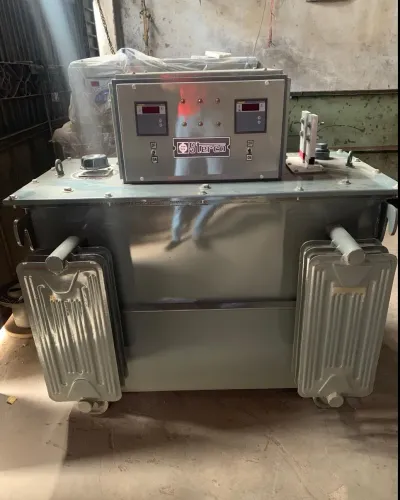
Available in balanced and unbalanced configurations. Air cooled up to around 250 KVA; oil cooled above that for continuous heavy-duty operation.
Oil cooled servo stabilizers
Filled with high-grade transformer oil for superior heat dissipation and insulation. Suited to continuous industrial duty, outdoor installation and high ambient temperatures. Longer service life under sustained full load.
Air cooled servo stabilizers
Lighter, lower maintenance and more compact. Ideal for indoor installations with moderate duty cycles and lower capacity requirements.
Unbalanced (independent phase) stabilizers
Each phase is corrected independently. Essential where your three-phase supply arrives with uneven phase voltages — a common reality on rural and overloaded feeders.
Key Features
Output accuracy of ±0.5% to ±1% — precise enough for CNC, medical imaging and laboratory instrumentation
Efficiency above 98% — correction losses stay negligible even at full load
Wide input range options to suit local supply conditions, including extended ranges for severe fluctuation areas
High-conductivity copper windings in both variac and buck-boost transformer
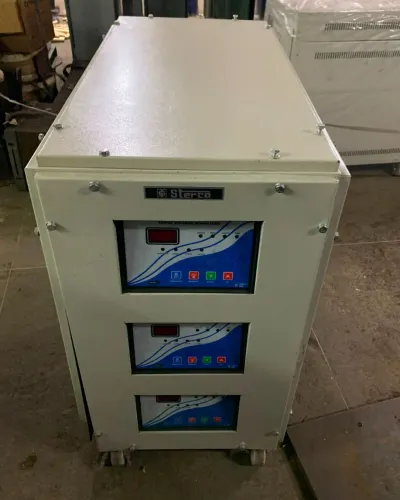
Digital metering for input voltage, output voltage, load current and phase indication
Built-in protections — high/low voltage cut-off, overload, single phasing preventer, short circuit, and phase reversal protection
Manual bypass switch so maintenance never means shutting down the plant
Time delay on restart to protect motor loads after a supply interruption
Powder-coated MS enclosure with IP protection options for dusty or outdoor sites
Where Sterco Stabilizers Are Working
Manufacturing — CNC machines, injection moulding, textile machinery, printing presses, induction furnaces
Healthcare — X-ray, CT and MRI installations, operation theatres, laboratory analysers
IT & telecom — server rooms, data centres, base transceiver stations
Commercial buildings — lifts, HVAC plant, lighting loads, hotels, shopping complexes
Agriculture & rural industry — pump sets, cold storage, rice and flour mills where supply quality is poorest
Process industry — chemical plants, pharma units, packaging lines
Why Choose Sterco
Sized to your actual load, not a round number. Send us your connected load, starting current profile and measured supply range. We will recommend capacity and input window based on what your site actually experiences.
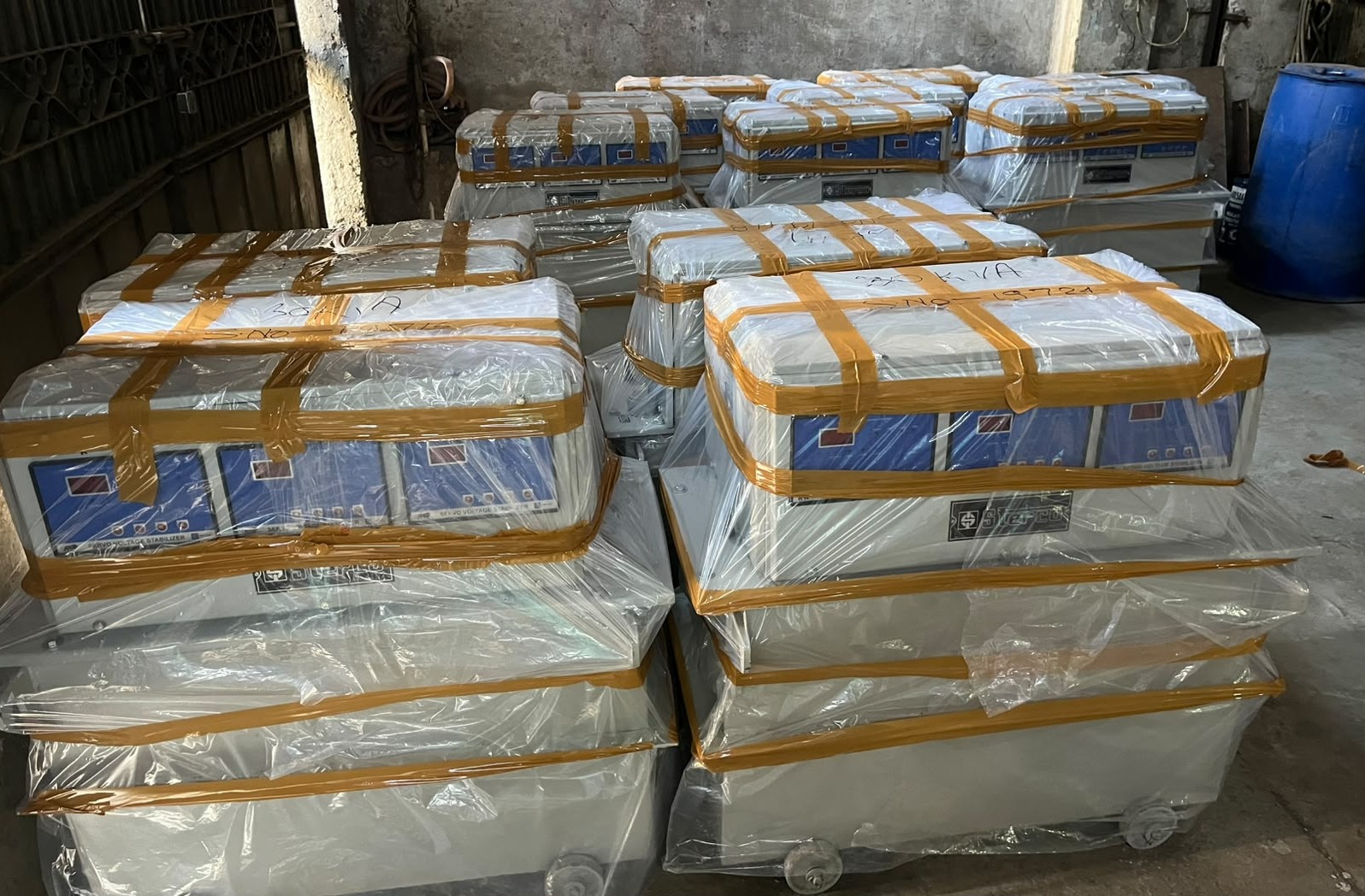
Manufactured in-house. Winding, assembly, painting and testing under one roof, with full-load testing and protection verification before dispatch.
Custom configurations. Non-standard input ranges, special enclosures, remote monitoring, integration with existing panels and DG sets — handled routinely.
Nationwide service and spares. Installation, commissioning, AMC contracts and genuine replacement parts backed by a manufacturer that has been in this business for the long haul.
Warranty and documentation. Every unit ships with test certificates, wiring diagrams and a clear warranty.
Frequently Asked Questions
What is the difference between a servo voltage stabilizer and a UPS?
They solve different problems. A stabilizer corrects voltage but needs incoming supply to function — if the grid fails, the output fails. A UPS stores energy in batteries and keeps your load running through a complete power cut, but typically has limited backup time. Many installations use both: a stabilizer to condition the mains, and a UPS or DG set for outage backup.
How do I select the right KVA rating?
Add up your total connected load in KVA, then add headroom of roughly 20 to 25 percent for future expansion and motor starting surges. If your load includes large induction motors, compressors or welding equipment, the inrush current may require a further margin. Sterco's team can size the unit correctly from your load list.
Oil cooled or air cooled — which should I buy?
Air cooled units are lighter, cheaper and fine for indoor installations up to moderate capacity with intermittent or medium duty. Oil cooled units handle heat far better, making them the right choice for higher capacities, continuous full-load running, high ambient temperatures and outdoor or dusty environments.
What is the difference between balanced and unbalanced three phase stabilizers?
A balanced stabilizer corrects all three phases together, assuming the input phases are reasonably equal. An unbalanced stabilizer regulates each phase independently. If your supply arrives with noticeably different voltages on R, Y and B — very common on overloaded or rural feeders — you need the unbalanced type.
Will a servo stabilizer reduce my electricity bill?
Indirectly and modestly. By preventing equipment from running at excessive voltage it can reduce wasteful consumption in certain loads, and by avoiding breakdowns it cuts downtime and repair cost. It should not be purchased primarily as an energy-saving device — its real value is protection and process consistency.
Does a servo stabilizer protect against voltage spikes and surges?
It handles sustained over-voltage and under-voltage very well, and Sterco units include high and low voltage cut-off. However, fast transient spikes from lightning or switching require dedicated surge protection devices, which can be supplied alongside the stabilizer.
Can it be used with a diesel generator?
Yes, and it is often advisable. DG output voltage can wander, particularly during load changes. Sterco stabilizers can be configured to work on both mains and DG supply, with appropriate input range settings for generator operation.
What maintenance does a servo stabilizer need?
Periodic inspection of carbon brushes and the variac track surface, checking of terminal tightness, cleaning of ventilation paths or radiator fins, and for oil cooled units, checking oil level and dielectric strength. Sterco offers annual maintenance contracts covering all of this.
How long does a servo voltage stabilizer last?
With correct sizing, proper installation and routine maintenance, a well-built servo stabilizer commonly gives 12 to 15 years or more of service. Carbon brushes are consumable and are replaced periodically, which is a minor and inexpensive job.
What is the price of a servo voltage stabilizer in India?
Price depends on KVA rating, single or three phase, cooling type, input voltage range, enclosure specification and protections required. A small single phase air cooled unit is very different in cost from a high-capacity oil cooled three phase installation. Share your load and site details with Sterco for an accurate quotation.
How much space and what installation conditions are needed?
Smaller air cooled units are compact and can be wall or floor mounted indoors. Larger oil cooled units need a level foundation, adequate clearance on all sides for cooling and maintenance access, and protection from direct rain if installed outdoors. Sterco provides site-preparation guidance with every order.
Get a Quote
Share your connected load, the voltage range your site actually sees, and your operating hours. Sterco's engineers will recommend the right capacity, cooling type and input window — and quote a unit built for your conditions.
Sterco — Power Conditioning Equipment Engineered in India.
Keywords