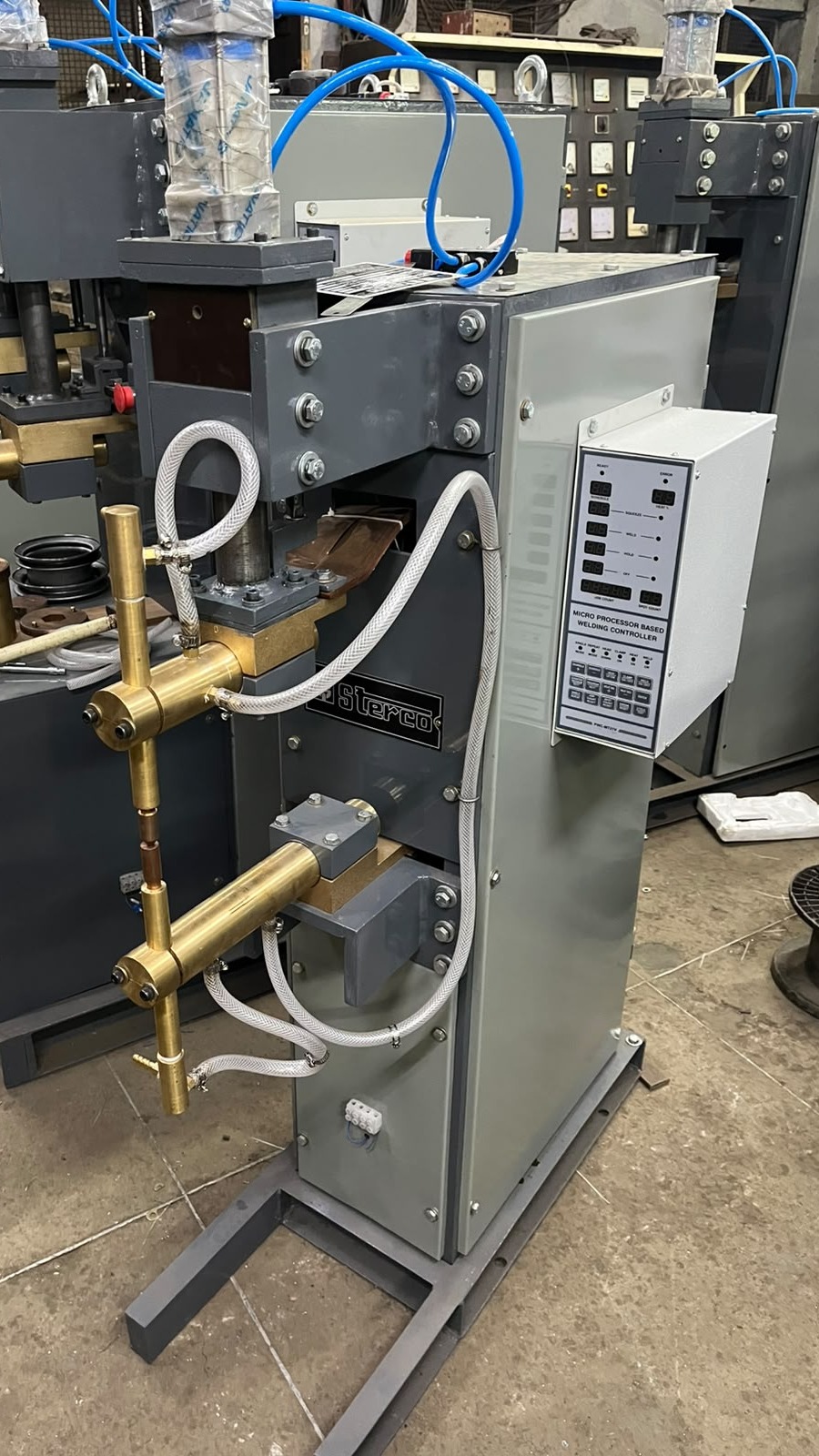
Projection Welding Machines by Sterco — Precision Multi-Spot Welding for Production Lines
When a single cycle has to place four nuts on a bracket with identical strength every time, spot welding stops being an option. Sterco projection welding machines concentrate current at pre-formed projections on the workpiece, so the weld happens exactly where you designed it to — no guesswork, no wandering electrodes, no rework.
Sterco has been building resistance welding equipment for the Indian manufacturing sector for decades, supplying automotive component makers, white goods manufacturers, fabricators and switchgear producers. Every machine is engineered, assembled and tested in-house.
What Is a Projection Welding Machine?
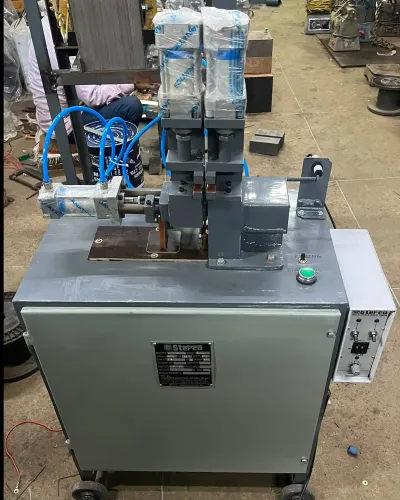
A projection welding machine is a type of resistance welding equipment that joins metal parts using embossed projections, dimples or natural contact points on one of the components. When the electrodes clamp down and current flows, heat builds up at those raised points. The projections collapse under pressure, and the parts fuse.
Unlike spot welding, where pointed electrodes define the weld location, projection welding uses large flat platens. That single difference changes everything: multiple welds in one shot, longer electrode life, cleaner surfaces and far better consistency across thousands of parts.
How Sterco Projection Welding Machines Work
The cycle runs in four controlled stages:
Squeeze — The upper platen descends via a pneumatic cylinder and applies pre-set force, seating the projections firmly against the mating part.
Weld — A high-amperage, low-voltage current passes through the joint. Resistance at the projections generates localised heat within milliseconds.
Forge/Hold — Pressure continues as the molten zone solidifies, ensuring a dense, void-free nugget.
Release — The platen retracts and the part is removed or indexed forward.
Sterco integrates a microprocessor or PLC-based weld controller that governs squeeze time, weld time, hold time, off time and current percentage — all storable as job programs, so changeover between components takes seconds rather than a shift.
Key Features of Sterco Projection Welding Machines
Robust C-frame or press-type fabricated steel body — stress-relieved to eliminate deflection under load and maintain platen parallelism over years of production.
Capacity range from 10 KVA to 400 KVA — covering light sheet metal work through heavy automotive assemblies.
Pneumatic force system with FRL unit, precision regulator and quick-exhaust valves for fast, repeatable pressure application.
PLC / microprocessor weld control with digital display, multi-schedule memory and current regulation for consistent heat input despite line voltage fluctuation.
Water-cooled transformer, platens and secondary circuit — sustains high duty cycle without thermal drift.
T-slotted platens that accept custom fixtures, locating pins and multi-nut tooling.
Foot-pedal, two-hand and auto-cycle operation modes, with safety interlocks and emergency stop as standard.
Optional add-ons — automatic nut feeders, servo-driven pressure heads, MFDC inverter controls, rotary index tables and weld-quality monitoring.
Applications
Sterco projection welders are working across:
Automotive — weld nuts and studs on chassis brackets, seat frames, door hinges, exhaust clamps, cross-members
Appliance manufacturing — washing machine drums, refrigerator liners, cooktop frames, chimney bodies
Electrical & switchgear — contact assemblies, terminal blocks, busbar connections, panel enclosures
Furniture & fabrication — steel racking, office furniture frames, shelving, wire products
Construction hardware — anchor plates, fixing brackets, mounting rails
Materials handled include mild steel, galvanised steel, HR/CR sheet, stainless steel and, with MFDC configurations, selected coated and dissimilar combinations.
Why Choose Sterco
Application engineering, not catalogue selling. Send us the component drawing and we will recommend throat depth, KVA rating, electrode layout and fixture design based on your actual joint.
Custom builds as standard practice. Non-standard throat depth, extended platens, special stroke lengths, integration with your existing automation — routine work for our design team.
Tooling and fixtures in-house. Copper alloy electrodes, locating fixtures and nut-feeding tooling designed alongside the machine, so the system arrives ready to produce.
Service across India. Installation, operator training, preventive maintenance contracts and spares availability from a company that will still be around when you need a transformer rewound.
Built to IS and CE-referenced standards with pressure testing, current calibration and trial welds on your samples before dispatch.
Frequently Asked Questions
What is the difference between projection welding and spot welding?
Spot welding uses pointed electrodes to force current through a small contact area, so the electrode tip decides where the weld lands. Projection welding uses flat platens and lets pre-formed projections on the part decide the weld location. The result is better positional accuracy, several welds in a single cycle and much longer electrode life, since the platens do not wear like pointed tips do.
Which KVA rating do I need for my application?
It depends on sheet thickness, material type, number of projections welded simultaneously and the duty cycle you plan to run. As a broad guide, light sheet metal with one or two projections typically needs 25–50 KVA, while multi-nut automotive brackets in thicker gauge often call for 100–250 KVA. Share your component drawing with the Sterco team for a specific recommendation.
Can a projection welding machine weld nuts and bolts to sheet metal?
Yes — this is one of the most common uses. Weld nuts and weld studs are manufactured with projections already formed on the flange. The machine places and fuses them in a single cycle, and with a multi-nut fixture you can weld several fasteners at once with uniform strength.
Can it weld stainless steel and galvanised sheet?
Stainless steel welds well on projection equipment, though it requires different current and force settings due to its higher resistivity. Galvanised and coated steels are also possible, but the zinc layer demands careful parameter control and more frequent electrode maintenance. An MFDC inverter-controlled Sterco machine gives noticeably better results on coated materials.
What is the price of a projection welding machine in India?
Pricing varies considerably with KVA rating, control type, throat depth, cooling arrangement and tooling requirements. A compact pneumatic unit sits at one end of the range and a fully automated high-capacity system with servo head and nut feeder at the other. Contact Sterco with your application details for an accurate quotation.
Do projection welding machines need a water supply?
Most models above the light-duty range do. Water cooling protects the transformer, secondary conductors and platens during continuous operation. Sterco supplies machines with cooling circuits ready for connection to a chiller or recirculating unit, and can recommend the right flow rate for your duty cycle.
How much floor space and power supply is required?
A mid-range C-frame machine typically occupies a footprint of around 1 to 1.5 square metres plus operator access. Power requirements are single-phase or three-phase depending on model and rating, with cable sizing and MCB ratings specified in the technical documentation supplied with every machine.
Does Sterco provide the fixtures and electrodes too?
Yes. Sterco designs and manufactures copper alloy electrodes, locating fixtures and component-specific tooling in-house, so the machine is commissioned as a working system matched to your part rather than as a bare frame.
What maintenance does the machine require?
Routine care involves checking electrode and platen surfaces for pitting, verifying coolant flow and temperature, draining the pneumatic FRL bowl, inspecting secondary connections for tightness, and confirming weld parameters periodically against a test coupon. Sterco offers preventive maintenance contracts and operator training at installation.
How long does delivery and installation take?
Standard configurations generally ship within a few weeks of order confirmation; custom-engineered systems take longer depending on tooling complexity. Sterco handles installation, commissioning and on-site operator training as part of the supply.
Get a Quote
Tell us what you are welding. Send your component drawing, material specification and target cycle time, and Sterco's engineering team will propose a machine configuration built around your production requirement.
When a single cycle has to place four nuts on a bracket with identical strength every time, spot welding stops being an option. Sterco projection welding machines concentrate current at pre-formed projections on the workpiece, so the weld happens exactly where you designed it to — no guesswork, no wandering electrodes, no rework.
Sterco has been building resistance welding equipment for the Indian manufacturing sector for decades, supplying automotive component makers, white goods manufacturers, fabricators and switchgear producers. Every machine is engineered, assembled and tested in-house.
What Is a Projection Welding Machine?
A projection welding machine is a type of resistance welding equipment that joins metal parts using embossed projections, dimples or natural contact points on one of the components. When the electrodes clamp down and current flows, heat builds up at those raised points. The projections collapse under pressure, and the parts fuse.
Unlike spot welding, where pointed electrodes define the weld location, projection welding uses large flat platens. That single difference changes everything: multiple welds in one shot, longer electrode life, cleaner surfaces and far better consistency across thousands of parts.
How Sterco Projection Welding Machines Work
The cycle runs in four controlled stages:
Squeeze — The upper platen descends via a pneumatic cylinder and applies pre-set force, seating the projections firmly against the mating part.
Weld — A high-amperage, low-voltage current passes through the joint. Resistance at the projections generates localised heat within milliseconds.
Forge/Hold — Pressure continues as the molten zone solidifies, ensuring a dense, void-free nugget.
Release — The platen retracts and the part is removed or indexed forward.
Sterco integrates a microprocessor or PLC-based weld controller that governs squeeze time, weld time, hold time, off time and current percentage — all storable as job programs, so changeover between components takes seconds rather than a shift.
Key Features of Sterco Projection Welding Machines
Robust C-frame or press-type fabricated steel body — stress-relieved to eliminate deflection under load and maintain platen parallelism over years of production.
Capacity range from 10 KVA to 400 KVA — covering light sheet metal work through heavy automotive assemblies.
Pneumatic force system with FRL unit, precision regulator and quick-exhaust valves for fast, repeatable pressure application.
PLC / microprocessor weld control with digital display, multi-schedule memory and current regulation for consistent heat input despite line voltage fluctuation.
Water-cooled transformer, platens and secondary circuit — sustains high duty cycle without thermal drift.
T-slotted platens that accept custom fixtures, locating pins and multi-nut tooling.
Foot-pedal, two-hand and auto-cycle operation modes, with safety interlocks and emergency stop as standard.
Optional add-ons — automatic nut feeders, servo-driven pressure heads, MFDC inverter controls, rotary index tables and weld-quality monitoring.
Applications
Sterco projection welders are working across:
Automotive — weld nuts and studs on chassis brackets, seat frames, door hinges, exhaust clamps, cross-members
Appliance manufacturing — washing machine drums, refrigerator liners, cooktop frames, chimney bodies
Electrical & switchgear — contact assemblies, terminal blocks, busbar connections, panel enclosures
Furniture & fabrication — steel racking, office furniture frames, shelving, wire products
Construction hardware — anchor plates, fixing brackets, mounting rails
Materials handled include mild steel, galvanised steel, HR/CR sheet, stainless steel and, with MFDC configurations, selected coated and dissimilar combinations.
Why Choose Sterco
Application engineering, not catalogue selling. Send us the component drawing and we will recommend throat depth, KVA rating, electrode layout and fixture design based on your actual joint.
Custom builds as standard practice. Non-standard throat depth, extended platens, special stroke lengths, integration with your existing automation — routine work for our design team.
Tooling and fixtures in-house. Copper alloy electrodes, locating fixtures and nut-feeding tooling designed alongside the machine, so the system arrives ready to produce.
Service across India. Installation, operator training, preventive maintenance contracts and spares availability from a company that will still be around when you need a transformer rewound.
Built to IS and CE-referenced standards with pressure testing, current calibration and trial welds on your samples before dispatch.
Frequently Asked Questions
What is the difference between projection welding and spot welding?
Spot welding uses pointed electrodes to force current through a small contact area, so the electrode tip decides where the weld lands. Projection welding uses flat platens and lets pre-formed projections on the part decide the weld location. The result is better positional accuracy, several welds in a single cycle and much longer electrode life, since the platens do not wear like pointed tips do.
Which KVA rating do I need for my application?
It depends on sheet thickness, material type, number of projections welded simultaneously and the duty cycle you plan to run. As a broad guide, light sheet metal with one or two projections typically needs 25–50 KVA, while multi-nut automotive brackets in thicker gauge often call for 100–250 KVA. Share your component drawing with the Sterco team for a specific recommendation.
Can a projection welding machine weld nuts and bolts to sheet metal?
Yes — this is one of the most common uses. Weld nuts and weld studs are manufactured with projections already formed on the flange. The machine places and fuses them in a single cycle, and with a multi-nut fixture you can weld several fasteners at once with uniform strength.
Can it weld stainless steel and galvanised sheet?
Stainless steel welds well on projection equipment, though it requires different current and force settings due to its higher resistivity. Galvanised and coated steels are also possible, but the zinc layer demands careful parameter control and more frequent electrode maintenance. An MFDC inverter-controlled Sterco machine gives noticeably better results on coated materials.
What is the price of a projection welding machine in India?
Pricing varies considerably with KVA rating, control type, throat depth, cooling arrangement and tooling requirements. A compact pneumatic unit sits at one end of the range and a fully automated high-capacity system with servo head and nut feeder at the other. Contact Sterco with your application details for an accurate quotation.
Do projection welding machines need a water supply?
Most models above the light-duty range do. Water cooling protects the transformer, secondary conductors and platens during continuous operation. Sterco supplies machines with cooling circuits ready for connection to a chiller or recirculating unit, and can recommend the right flow rate for your duty cycle.
How much floor space and power supply is required?
A mid-range C-frame machine typically occupies a footprint of around 1 to 1.5 square metres plus operator access. Power requirements are single-phase or three-phase depending on model and rating, with cable sizing and MCB ratings specified in the technical documentation supplied with every machine.
Does Sterco provide the fixtures and electrodes too?
Yes. Sterco designs and manufactures copper alloy electrodes, locating fixtures and component-specific tooling in-house, so the machine is commissioned as a working system matched to your part rather than as a bare frame.
What maintenance does the machine require?
Routine care involves checking electrode and platen surfaces for pitting, verifying coolant flow and temperature, draining the pneumatic FRL bowl, inspecting secondary connections for tightness, and confirming weld parameters periodically against a test coupon. Sterco offers preventive maintenance contracts and operator training at installation.
How long does delivery and installation take?
Standard configurations generally ship within a few weeks of order confirmation; custom-engineered systems take longer depending on tooling complexity. Sterco handles installation, commissioning and on-site operator training as part of the supply.
Get a Quote
Tell us what you are welding. Send your component drawing, material specification and target cycle time, and Sterco's engineering team will propose a machine configuration built around your production requirement.
Keywords