Copper Chromium Zirconium (CuCrZr) Electrodes by Sterco — Strength That Doesn't Give Up Conductivity
Every resistance weld lives or dies at the electrode tip. Choose a material that's too soft and the tip mushrooms after a few hundred cycles, dragging weld quality down with it. Choose one that's too hard and conductivity suffers, weld heat becomes inconsistent, and you're fighting the machine instead of the joint.
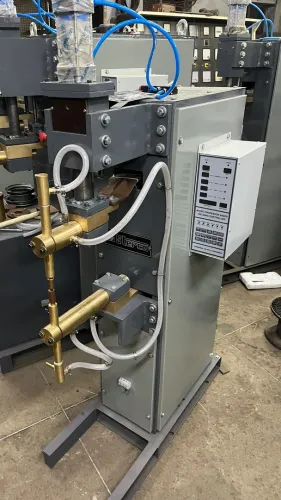
Copper chromium zirconium hits the balance most production welding actually needs: strong enough to hold its shape under repeated force and heat, conductive enough to deliver clean, consistent current. Sterco manufactures CuCrZr electrodes and electrode components precision-machined for its own welding machines and for third-party resistance and projection welding equipment.
What Is Copper Chromium Zirconium?
Copper chromium zirconium (CuCrZr) is a precipitation-hardened copper alloy containing roughly 0.5–1.2% chromium and small additions of zirconium, typically produced to a specification such as C18150. The alloy is solution-treated and aged, which forms fine chromium and zirconium precipitates through the copper matrix. Those precipitates are what give the alloy its defining property: mechanical strength and hardness well above pure copper, retained even at elevated temperature, while conductivity stays close to 80% IACS or higher.
That combination — retained strength at weld temperature plus high conductivity — is exactly what an electrode tip needs, since it is repeatedly heated, clamped and forced against the workpiece thousands of times per shift.
Why CuCrZr Over Other Electrode Materials?
Versus pure copper (C11000): Pure copper conducts brilliantly but softens quickly under welding heat and pressure, mushrooming and losing tip geometry fast. CuCrZr holds its shape far longer under identical duty.
Versus copper tungsten or tungsten alloys: Tungsten-based materials resist wear extremely well but carry much lower conductivity, generating more resistive heat in the electrode itself — useful for specific wear-critical applications, wrong for general production welding where current efficiency matters.
Versus copper beryllium (CuBe): CuBe offers comparable strength but carries known health and handling concerns during machining due to beryllium content. CuCrZr delivers similar mechanical performance without that handling burden, which is why it has become the standard choice across most resistance and projection welding lines.
Key Properties
Hardness: Typically 38–46 HRB in the solution-treated and aged condition, giving strong resistance to mushrooming and deformation
Electrical conductivity: Approximately 75–85% IACS — high enough to keep current delivery efficient and weld heat consistent
Softening resistance: Retains hardness and strength at elevated temperatures far better than pure copper, critical for repeated weld cycling
Thermal conductivity: High enough to dissipate weld heat quickly, protecting the tip and reducing cycle-to-cycle heat buildup
Machinability: Machines cleanly to precise tip geometries and tolerances required for projection and spot welding work
Sterco Electrode Range in CuCrZr
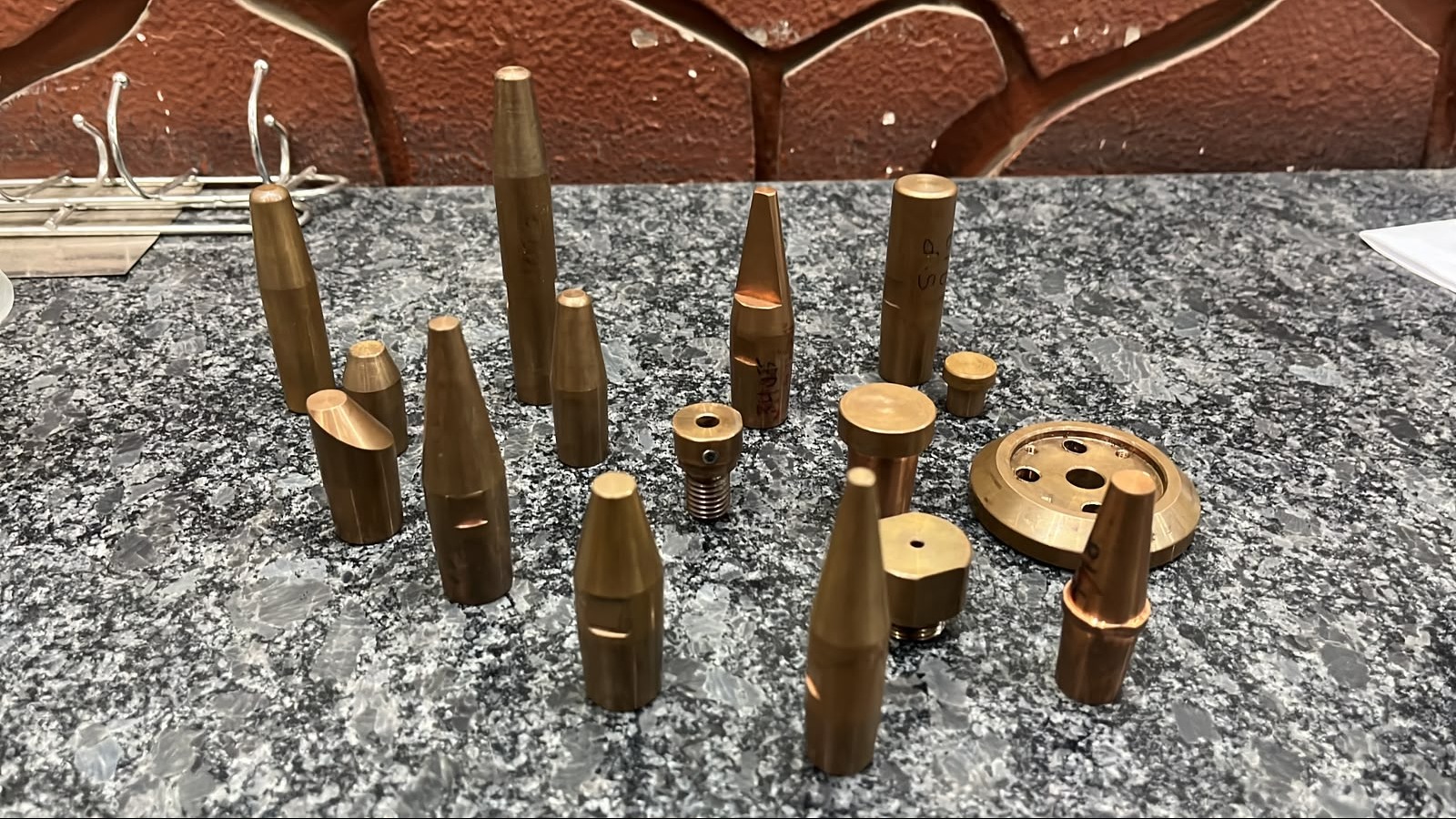
Spot welding electrode tips — pointed, truncated, dome and flat-face geometries for standard spot welding
Projection welding platens and inserts — flat and custom-contoured faces sized to your fixture and part geometry
Electrode holders and shanks — machined to standard and custom taper/thread specifications for compatibility with existing machine heads
Custom-profile electrodes — machined to your drawing for non-standard projection layouts, multi-point fixtures or awkward part access
Adapters and extensions — for reaching recessed or offset weld locations without redesigning the whole electrode assembly
Applications
Automotive component welding — nut and stud projection welding, body panel spot welding, bracket assembly
Appliance manufacturing — spot and projection welds on sheet metal enclosures and frames
Electrical and switchgear assembly — terminal and contact welding where consistent current delivery matters
Wire and mesh welding — electrode contacts for wire mesh and grid welding machines
General sheet metal fabrication — any production spot or projection welding line running sustained cycles
Why Choose Sterco Electrodes
Machined to your fixture, not a generic catalogue shape. Send your electrode drawing or machine specification, and Sterco machines to the exact geometry, taper and thread your equipment requires.
Consistent alloy quality. Sourced and processed to maintain the hardness and conductivity specification batch after batch, so electrode life doesn't vary unpredictably between orders.
Compatible with your existing machine. Whether it's a Sterco machine or another manufacturer's equipment, electrodes are made to match your holder and fixture dimensions.
Fast turnaround on standard geometries, with custom and multi-point electrode sets machined to drawing for specialised production setups.
Frequently Asked Questions
What does the 'zirconium' add to copper chromium electrodes?
Zirconium refines the alloy's grain structure and works alongside chromium to form the fine precipitates responsible for the alloy's strength at elevated temperature. Its addition is small but improves softening resistance and overall consistency of mechanical properties compared to a chromium-only copper alloy.
How long do CuCrZr electrodes typically last compared to pure copper?
Service life depends heavily on current, pressure, material welded and duty cycle, but CuCrZr electrodes generally significantly outlast pure copper electrodes in the same application because they resist mushrooming and deformation far better under repeated heat and pressure cycling.
Can CuCrZr electrodes be re-dressed and reused?
Yes. Worn tip geometry can typically be re-machined or dressed back to the correct profile several times before the electrode reaches the end of its usable material, extending service life significantly beyond the first dressing.
Is CuCrZr suitable for both spot welding and projection welding?
Yes, it is widely used for both. The specific geometry differs — pointed or domed tips for spot welding, flat or contoured platens for projection welding — but the alloy's strength and conductivity profile suits both processes.
Does CuCrZr require any special cooling?
Water cooling through the electrode holder is standard practice for sustained production welding, regardless of electrode alloy, and CuCrZr benefits from it the same way other copper alloys do — cooling helps maintain hardness and extends service life under continuous duty.
Can Sterco machine electrodes to match a competitor's welding machine?
Yes. Sterco machines CuCrZr electrodes, holders and platens to customer drawings and to match the taper, thread and dimensional specification of existing machines, regardless of the original equipment manufacturer.
What is the difference between solution-treated and aged CuCrZr and other tempers?
The solution-treated and aged condition is what develops the alloy's characteristic hardness and softening resistance through precipitation hardening. Electrodes are supplied in this condition because it delivers the mechanical properties needed for welding service; other tempers exist for general engineering use but are not typically used for electrode applications.
How do I know what electrode geometry I need?
Geometry depends on your part design, projection layout or spot weld location, fixture access and current requirements. Sharing your component drawing or existing electrode sample with Sterco allows the right profile, face diameter and taper to be specified accurately.
What is the price of CuCrZr electrodes?
Price depends on electrode size, geometry complexity, quantity and whether it's a standard catalogue shape or a custom-machined design. Share your specification or drawing with Sterco for an accurate quotation.
Do CuCrZr electrodes need any special storage or handling?
No special handling is required beyond standard practice for precision-machined copper components — keeping tip faces free from damage and contamination before installation to preserve the machined geometry and surface finish.
Get a Quote
Share your electrode drawing, machine specification or an existing sample, and Sterco will machine CuCrZr electrodes to match — standard geometries or fully custom designs.
Sterco — Resistance Welding Machines and Electrodes Engineered in India.
Keywords